Disc Prolapse and Sciatica: What Is Really Going On?
What is A Disc Prolapse?
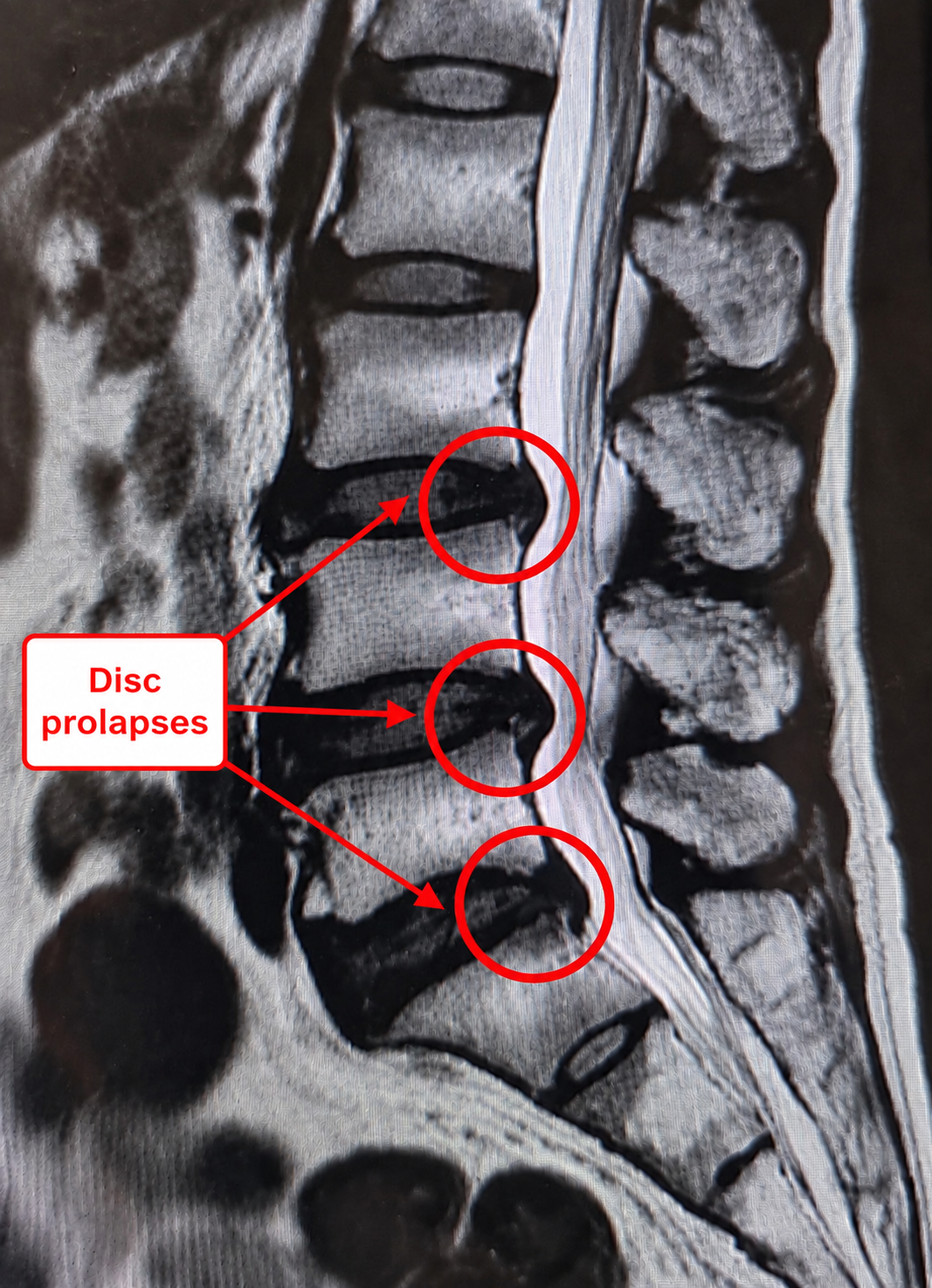
Lower back pain and sciatica are extremely common problems that we see in musculoskeletal practice. One possible cause is a lumbar disc prolapse, sometimes called a 'slipped' or herniated disc. The discs sit between the bones of the spine and act as shock absorbers. A disc prolapse occurs when some of the softer material inside a disc (nucleus pulpsosus) pushes through its outer layers (the annulus fibrosus). In the lower back, disc problems commonly affect L4/5 and L5/S1, although L3/4 can also be affected [1]. If the prolapsed disc irritates or compresses a nearby nerve root, this can cause sciatica. Symptoms may include pain travelling from the lower back or buttock into the back or side of the leg, sometimes with tingling, numbness or weakness.
A Disc Prolapse Does Not Always Cause Pain
Finding a disc prolapse on an MRI does not automatically mean it is causing somebody’s pain. Research has found disc bulges and protrusions in people who have no back pain or sciatica at all, and these findings become increasingly common as we get older [2]. This is why scan results should always be considered alongside a person’s symptoms and physical examination.
Why Does a Disc Prolapse Happen?
Disc problems are usually caused by a combination of factors rather than one particular movement. Age-related changes, genetics, body weight and repeated physical loading can all contribute [1].
Long periods sitting at a desk or driving, prolonged standing, poor lifting technique and exercising with poor form may also aggravate an already sensitive lower back. Regular movement, changing position and using good technique during exercise and lifting can therefore be helpful.
What Treatments Can Help?
The good news is that many people improve without surgery. Staying active and gradually returning to normal exercise is generally encouraged. Walking, strengthening, appropriate yoga and mobility exercises can all be useful [3]. Comfortable, supportive footwear can also make walking and exercise easier.
For persistent or severe sciatica, an epidural corticosteroid injection may sometimes be recommended. This can provide short-term pain relief for some people, although injections do not work for everybody and are not a guaranteed cure [3].
Weight Changes and Muscle Strength
Body weight can influence the load placed through the lower back. Being significantly overweight may increase mechanical loading, while rapid weight loss can present different challenges.
Weight-loss medicines such as Mounjaro (tirzepatide) can produce significant weight reduction, but some of this may include lean body mass as well as body fat [4]. This does not mean Mounjaro directly causes sciatica. However, maintaining muscle strength during significant weight loss is important, as reduced muscle mass may affect strength and physical function. Regular resistance exercise, walking, appropriate yoga and good nutrition can therefore be particularly useful during weight loss.
Can Osteopathy and Sports Massage Help?
Osteopathy and sports massage may help manage some of the pain, stiffness and muscular tension associated with lower back problems and sciatica. Treatment cannot physically push a prolapsed disc back into place, but manual therapy may help improve movement and make it easier for someone to remain active.
Osteopathic treatment may include gentle mobilisation, soft-tissue techniques and advice on movement and exercise. Sports massage can also target tight or uncomfortable muscles around the lower back, hips and gluteal region.
NICE recommends that manual therapy, including spinal mobilisation and massage, can be considered for lower back pain with or without sciatica, but it should be used as part of a treatment package that includes exercise [3].
Overall, having a disc prolapse does not necessarily mean living with long-term pain. Keeping active, maintaining muscle strength and gradually returning to normal movement can make a significant difference.
References
[1] Amin, R.M., Andrade, N.S., Neuman, B.J. (2017) ‘Lumbar disc herniation’, Current Reviews in Musculoskeletal Medicine, 10, pp. 507–516.
[2] Brinjikji, W., Luetmer, P.H., Comstock, B., Bresnahan, B.W., Chen, L.E., Deyo, R.A., Halabi, S., Turner, J.A., Avins, A.L., James, K., Wald, J.T., Kallmes, D.F., Jarvik, J.G. (2015) ‘Systematic literature review of imaging features of spinal degeneration in asymptomatic populations’, American Journal of Neuroradiology, 36(4), pp. 811–816.
[3] National Institute for Health and Care Excellence (NICE) (2020) Low back pain and sciatica in over 16s: assessment and management (NG59). London: NICE.
[4] Sargeant, J.A., Henson, J., King, J.A., Yates, T., Khunti, K., Davies, M.J. (2019) ‘A review of the effects of glucagon-like peptide-1 receptor agonists and sodium-glucose cotransporter 2 inhibitors on lean body mass in humans’, Endocrinology and Metabolism, 34(3), pp. 247–262.